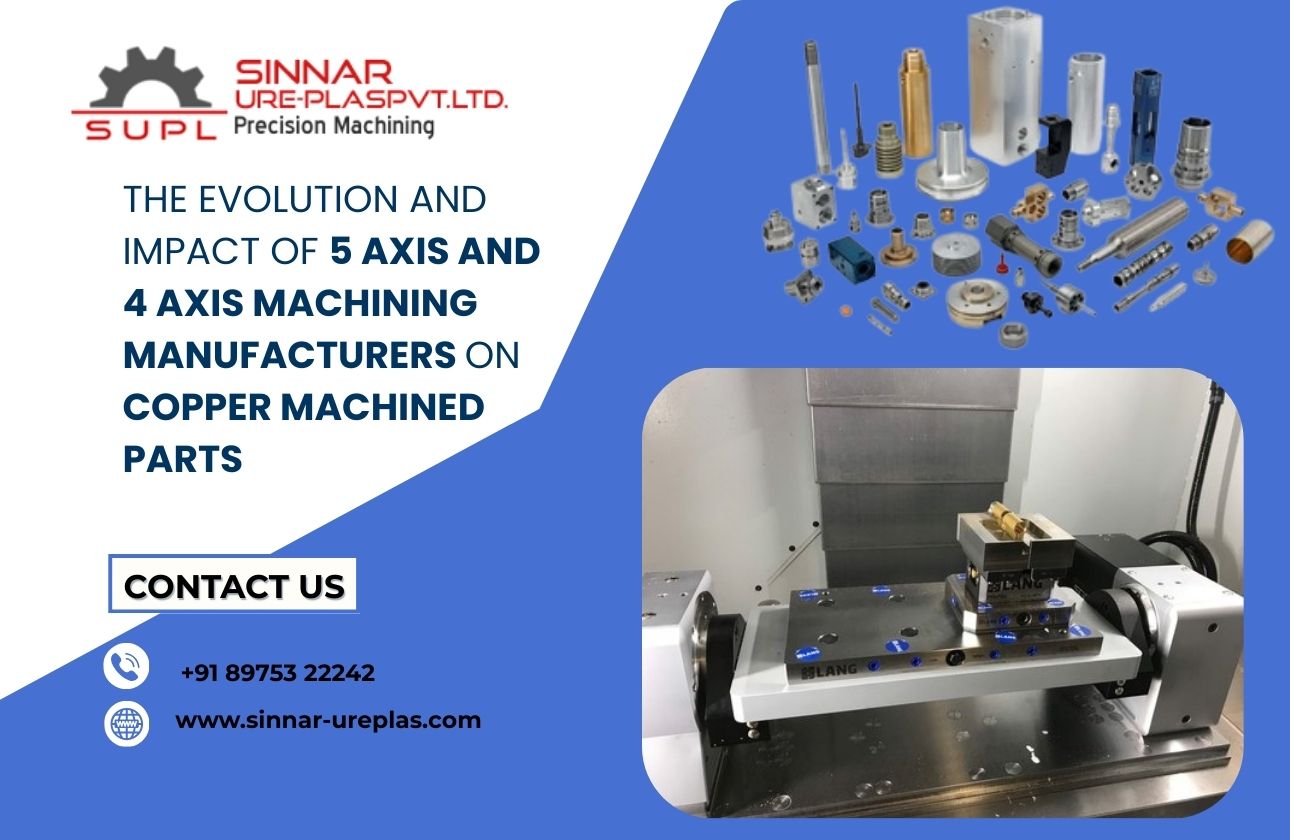
In the rapidly advancing world of manufacturing, precision and efficiency are key. Both 5 Axis Machining Manufacturers and 4 axis machining manufacturers have significantly transformed how complex components, such as copper machined parts, are produced. As industries demand higher precision and more complex geometrical parts, these advanced machining techniques have proven to be pivotal.
Understanding 5 Axis Machining
5 axis machining involves using a machine tool that can move a part or a tool along five different axes simultaneously. This is particularly beneficial for complex components requiring intricate detailing and precise dimensional tolerances. Compared to older 3 axis machines, 5 axis machining allows for the reduction of set up time, minimizes errors, and improves surface finishes.
The Role of 4 Axis Machining Manufacturers
While not as versatile as 5 axis machines, 4 axis machining still plays a crucial role in part manufacturing. The fourth axis, typically a rotational axis, allows the workpiece to be rotated and machined from multiple angles without additional setups. This capability enhances productivity and precision, making it a valuable tool for manufacturers specializing in producing less complex, yet detailed parts.
Copper Machined Parts: Challenges and Solutions
Copper is highly appreciated in various industries due to its excellent thermal and electrical conductivity properties. However, it poses significant machining challenges, such as issues with chip formation and tool wear. Here, 5 and 4 axis machining manufacturers come into play, offering solutions that optimize speeds and feeds, employ advanced tooling strategies, and reduce cooling requirements to successfully machine copper parts.
Benefits to Your Business
Partnering with advanced 5 Axis Machining Manufacturers can benefit businesses across multitudinous sectors including aerospace, automotive, electronics, and medical devices. The precision offered by these technologies in manufacturing copper parts ensures components that adhere to stringent quality standards, which, in turn, drives efficiency in downstream production processes.
Future Trends and Innovations
As technology continues to evolve, manufacturers are embracing digital transformation through smart manufacturing and industry 4.0 principles. This includes using IoT and AI to facilitate more predictive maintenance, optimizing production workflows, and integrating 3D modeling with machining operations to enhance accuracy and reduce waste.
In conclusion, the advancements in 5 axis and 4 axis machining have not only bolstered the manufacture of copper machined parts but also set new benchmarks in precision and efficiency that drive competitive advantage across industries. As we forge ahead, embracing these technologies will no doubt propel manufacturing capabilities and elevate industries to new heights.
Published on November 30, 2025 by Admin